Archive for category: Uncategorized

For project managers and estimators in manufacturing and fabrication, the choice between waterjet cutting vs. laser cutting is a critical decision that directly impacts budgets, timelines and product quality. Selecting the correct method is essential for minimizing material waste, preventing unnecessary secondary finishing and ensuring that parts meet specifications.

Nationwide Architectural Metals, Inc. can help you select the most effective and cost-efficient method for your specific project requirements.

A Technical Overview of Each Cutting Process

The fundamental difference between waterjet and laser cutting lies in how each technique removes material. Laser cutting is a thermal process that uses a high-powered, focused beam of light to melt or vaporize the material, creating a small heat-affected zone (HAZ).

In contrast, waterjet cutting is a mechanical erosion process. It uses a supersonic, high-pressure stream of water mixed with an abrasive garnet to cut through materials without generating heat, thus eliminating any HAZ.

Key Decision Factors

When determining whether laser or waterjet cutting is the optimal choice for your project, consider these four key factors:

  • Material compatibility and thickness: Waterjet offers unparalleled versatility to cut nearly any material, from thick stainless steel and aluminum to composites, laminates, stone and glass. Laser cutting is primarily for metals and is significantly faster on thin to medium-gauge sheets — typically under 1 inch — making it ideal for high-volume sheet metal fabrication.
  • Precision and edge quality: One of the key advantages of waterjet cutting vs. laser cutting is that the former offers no thermal distortion, making it essential for aerospace components or heat-treated alloys where compromised material integrity is unacceptable.
  • Cost-effectiveness: The waterjet vs. laser cutting cost comparison depends on the application. For high-volume, thin metal parts, laser cutting is generally faster and more affordable. For thick, reflective or heat-sensitive materials where lasers are not an option, waterjet becomes the most cost-effective solution.

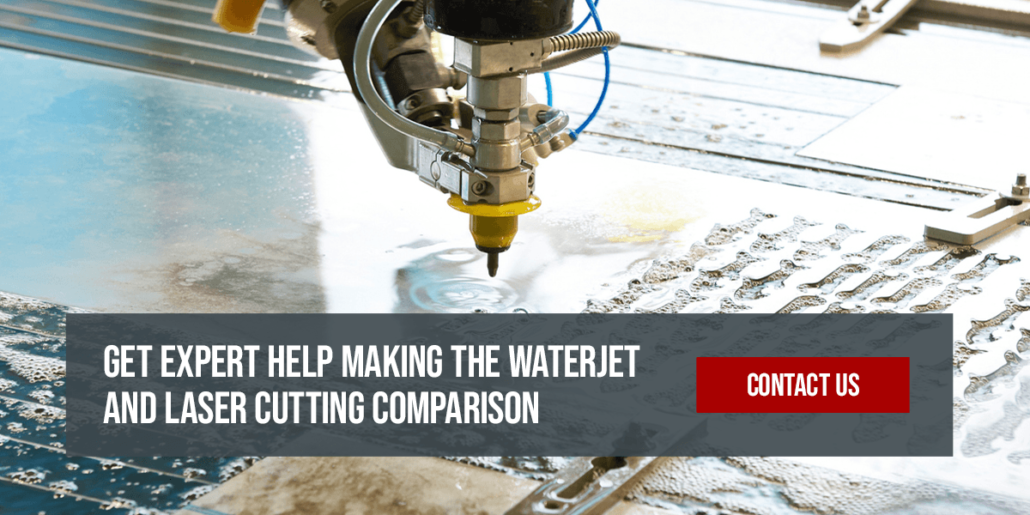
Get Expert Help Making the Waterjet and Laser Cutting Comparison

Ultimately, the best cutting method is entirely dependent on your project’s unique needs. Partnering with a fabricator that has deep expertise and advanced equipment in both technologies is crucial to ensuring you receive an unbiased, effective solution.

NAM has the experience and in-house capabilities to handle your project, whether it requires the speed of laser cutting or the versatility of a waterjet. Contact our team today for a custom quote and to ensure the completion of your project with precision and quality.

Get expert help making the waterjet and laser cutting comparison

Underbidding the finishing labor for a complex job is a gamble. Relying on manual field polishing can slow down project completion. Embracing solutions that stabilize project budgets reduces these risks. It’s why project managers, estimators and other decision-makers are choosing pre-polished metals.

Pre-Polishing vs. Field Polishing

It’s crucial that you deliver a solution that meets the project’s specifications. Here’s how pre-polished metals compare to field-polished options:

  • Labor: Field polishing results depend on the availability and cost of skilled labor. Pre-polished work has a quality machine-grade finish every time.
  • Consistency: Manual hand polishing in the field can cause streaking and uneven grain. This approach can lead to client rejection due to poor workmanship.
  • Delays: Sending raw, fabricated parts to the worksite exposes your parts to potential damage in transit, which would lead to necessary rework, repairs or more intensive polishing in the field.
  • Worksite conditions: When field polishing, laborers often do not have access to a controlled environment with proper ventilation or ample room to work.
  • Cleanup: Polishing architectural components at the jobsite creates dust that can contaminate other areas of your project, requiring additional time to set up protection and clean up afterward.

Benefits of Pre-Polished Metals

Achieving a uniform polish grain is almost impossible to do by hand. The benefits of pre-polished metals for commercial construction jobs and other projects include:

  • Speed: Machine-grade finished materials like pre-polished metals quicken processes. Shops can cut, assemble and ship immediately.
  • Cost certainty: Pre-polished metals eliminate variable labor costs. This consistency turns an obstacle into a fixed material cost, improving bid estimate accuracy.
  • Quality: Machine-polished materials deliver uniform quality in all areas, including aesthetics and specifications.
  • Less waste and rework: A factory-controlled finish reduces the chances of material rejection, rework and scrap costs.

For project managers and estimators, eliminating the risks associated with finishing cost guesswork streamlines processes and enhances reputation.

Reduce Labor and Increase Quality for Your Next Bid

Nationwide Architectural Metals’ (NAM) leadership is built on generations of polishers and advanced polishing solutions. We don’t just take your order. Instead, our team works with you to suggest substrates and finishes to deliver the best product for your specific application.

We’ve been a one-stop shop for pre-polished stainless steel, aluminum, brass and bronze since 1981. We understand how simplifying procurement can benefit complex projects. It’s one of the reasons we also offer custom solutions.

Are you looking to eliminate the guesswork and implement consistency for finishing costs? Contact us before your next bid.

Executing ambitious architectural designs requires both structural integrity and aesthetic perfection. For custom decorative elements and components like elevator sills, intricate facades and specialized handrails, you need a partner who understands the nuance of design as thoroughly as the demands of commercial production timelines. Knowing exactly how to evaluate and select an ornamental metal fabricator serves as a critical first step to help your metal shop deliver precise and ornate metalwork for your clients.

The Difference Between Ornamental and Structural Fabrication

Not all facilities that cut metal can produce high-end decorative components. While standard metal fabrication shops excel at producing high-volume, load-bearing frameworks like I-beams, they rarely possess the specialized machinery or fine-polishing expertise required for highly visible pieces.

Modern commercial buildings increasingly use decorative metal as functional art, merging strict safety requirements with sleek, minimalist aesthetics. Achieving this balance requires a fabricator who intimately understands how different alloys react to specific cutting and finishing techniques, rather than treating all metal as standard structural steel.

Key Capabilities to Look for in Custom Metal Fabricators

For precise aesthetics and reliable timelines, you must vet potential partners based on their in-house capabilities. Prioritize these specific operational strengths when choosing an architectural metal fabricator.

Advanced Precision Cutting

Intricate architectural designs require more than basic punches and shears. Knowing how to choose a custom metal fabricator means verifying their equipment list. Look for fabricators offering metal waterjet cutting services and those with advanced CNC laser cutting capabilities. These technologies produce clean edges, tight tolerances and complex geometries without introducing heat distortion that can compromise the metal’s structural or aesthetic integrity.

Deep Stock Metal Inventory

Maintaining project timelines requires immediate access to premium materials. The ideal custom metal fabrication company maintains a vast, pre-polished inventory of high-quality metals, including various grades of stainless steel, brass, bronze and aluminum. An extensive on-site inventory minimizes wait times for sourcing raw materials, enabling prompt fabrication of your projects.

Specialized Polishing and Finishing

The finish defines any ornamental metal component. A premium fabricator must possess extensive, hands-on experience delivering precise textures. Whether your project requires a standard #4 satin finish, a complex non-directional pattern or a flawless mirror polish, your fabrication partner must execute it consistently across large batches. Look for a facility that offers dedicated metal polishing and finishing services to attain total visual uniformity.

Reliable One-Stop Shop Approach

Keeping metal cutting and polishing under one roof provides seamless quality control and highly efficient lead times. From the initial selection of raw sheet metal through the final polished product, using a single-source fabricator simplifies project management and ensures exact adherence to your specifications.

Create Precise Ornamental Metalwork With Custom Fabrication

Partner with Nationwide Architectural Metals for ornamental and other custom fabrication requests. We have over 40 years of hands-on polishing and fabrication experience in the commercial construction industry. Our fabricators deliver exceptional, consistent quality and craftsmanship to every project. We also maintain a comprehensive inventory of metals and provide all fabrication services under one roof, offering speed and reliability to project managers and metal shops.

Contact our team today to discuss your architectural project specifications. Our experts can also advise you on material selection and answer any questions about our fabrication services.

The right metal finish can transform an architectural project, impacting everything from its weathering and light response to its long-term durability and maintenance needs. More than just a cosmetic choice, it is a critical performance specification. This guide explores the diverse metal finishing options available for commercial and institutional architecture, ensuring you make informed decisions that stand the test of time.

Base Metals and Finish Compatibility

The base metal determines which finishes are viable and how they perform. Depending on the project’s location and goals, some metals may be more suitable than others.

Stainless Steel

Stainless steel accepts mechanical polishing better than any other architectural metal. Standard grades are 304 and 316. Grade 316 is recommended for coastal and marine adjacent projects because its molybdenum content provides significantly better chloride resistance. Stainless pairs well with glass and stone in facade and interior applications.

Aluminum

Aluminum is lighter, lower cost and well-suited to anodizing and powder coating. It does not achieve the mirror polish possible with stainless steel, but its weight advantage and coating versatility make it the dominant choice for curtain wall, window framing and exterior cladding.

Brass and Bronze

Brass and bronze produce color warmth that other architectural metals cannot replicate. Both develop patina naturally. The decision to maintain the metal’s original appearance or allow it to build a patina must be made at the specification stage, as it determines the full finishing and protection approach.

Polished and Brushed Finishes

Mechanical finishes physically alter the metal surface using abrasives, brushes or buffing compounds. These are the most common architectural metal finishes in commercial interiors:

Satin/Brushed

A satin or brushed finish is produced by running progressively fine abrasives (10 to 240 grit) in one direction. This process creates fine parallel lines with low reflectivity, offering good fingerprint and scratch masking. It is standard for handrails, elevator interiors, wall panels and column covers.

Mirror

A mirror finish is achieved through successive polishing stages with increasingly fine compounds, creating near optical reflectivity with virtually no visible grit lines. This finish requires dedicated maintenance — fingerprints, water spots and micro scratches are all highly visible. It is appropriate for feature walls, sculpture and accent elements with a committed cleaning program.

Pre-Buff

Pre-buff is a semi-reflective finish with a slightly clouded appearance. It provides visual depth without the maintenance demands of a mirror finish. This finish is suitable where reflectivity is desired but full mirror finish upkeep is not practical.

Non-Directional/Orbital

Random orbital sanding creates a swirl pattern that masks directional imperfections and blends well across fabricated joints. It is effective on curved surfaces and complex geometries where maintaining consistent linear grain is difficult.

Surface roughness also affects corrosion behavior. Smoother finishes shed moisture and contaminants more readily. A polished stainless panel in a coastal application will outperform a rougher satin finish on the same building, all else being equal.

Applied finishes add a protective or decorative layer to the base metal

Powder Coating, Anodizing, PVD and Other Coatings

Applied finishes add a protective or decorative layer to the base metal. Selection depends on the balance required between color range, durability, repairability and cost.

High Durability Coatings

  • Powder coating is an electrostatically applied dry powder, oven-cured into a hard, uniform film. It has a broad color palette, solid UV stability, and is compatible with steel, aluminum and most other metals. AAMA 2604 and 2605 specifications govern architectural grades, with 2605 rated for the most demanding exterior exposures. Powder coat is a surface layer, and impact damage can expose the base metal.
  • Anodizing is an electrochemical process that converts aluminum’s natural oxide layer into a hard, integral coating. Because it becomes part of the metal, it will not peel or flake. It has strong abrasion resistance, UV stability and a metallic depth that applied topcoats cannot match. Type II is standard for decorative architectural use, and Type III (hard coat) is specified for high wear applications. The color range can be narrower than powder coating.
  • Physical vapor deposition (PVD) deposits a thin, extremely hard metallic layer onto stainless steel in a vacuum chamber. It produces the appearance of brass, bronze, copper or gold on a corrosion-resistant substrate, without the patina or tarnishing associated with those metals. It has superior scratch and fade resistance compared to traditional plating, and is increasingly specified for elevator panels, lobby interiors and exterior hardware.

Protective and Cosmetic Coatings

  • PVDF/Fluoropolymer paint is the standard coating system for exterior curtain wall and architectural metal roofing. It delivers exceptional color retention and weatherability over 20 to 30 years. AAMA 2605 is the governing specification.
  • Clear coats are applied over polished brass, bronze or copper to preserve the original appearance and prevent patina formation. This coating performs well in interior applications, but UV exposure degrades most clear coats within a few years, so exterior installations require scheduled reapplication.

Metal Surface Preparation

The preparation stage determines adhesion, consistency and long-term finish durability.

For mechanical polishing, the starting condition of the raw stock controls the result. Mill scale, scratches, weld marks and contaminants all come through to the final surface. This is why polishing in-house rather than sourcing prefinished material is best. Controlling every stage from raw stock through final polish eliminates the handoff variables that produce inconsistent results.

For applied coatings, adhesion depends entirely on substrate cleanliness and profile. Degreasing, chemical etching and conversion coatings create the bond that keeps a finish intact for decades. The quality of this stage directly determines coating longevity.

A complete finish specification includes three components alongside the finish callout itself:

  1. Preparation process and method
  2. Pretreatment chemistry
  3. Precoating inspection criteria

Selecting the Right Finish

Choosing from available metal finishing options requires weighing performance factors alongside aesthetics. At Nationwide Architectural Metals, we specialize in architectural metal fabrication. These are the criteria we apply to every project:

  • Determine environmental factors: Environmental conditions significantly impact the longevity and appearance of metal finishes. Coastal air, industrial pollutants and high humidity eliminate certain finishes regardless of visual appeal. For instance, while unprotected polished brass is aesthetically pleasing, it is unsuitable for harsh environments. Anodized aluminum, PVD-coated stainless steel and PVDF surface coatings offer superior resistance to aggressive exposures, making them ideal choices for challenging environments.
  • Match finish to maintenance capacity: High-reflectivity finishes, such as mirror finishes, require consistent and intensive upkeep to prevent water spots, fingerprints and micro-scratches. When choosing a finish, it is crucial to consider the maintenance resources realistically available throughout the building’s service life. Opting for a less demanding finish can ensure long-term aesthetic appeal without excessive maintenance costs.
  • Specify early in design: The choice of metal finish influences various project aspects, including metal selection, fabrication sequence, lead time and overall cost. Late-stage changes can result in rework, delays and potential quality compromises. Involving Nationwide Architectural Metals early in the design development process, rather than at the shop drawing stage, helps avoid these issues and ensures a more streamlined and cost-effective project.
  • Factor in field repairability: Certain metal finishes are easier to repair on-site than others. For example, #4 brushed stainless steel can be blended relatively seamlessly in the field, while PVD coatings cannot be easily repaired. In high-traffic installations or areas prone to incidental contact damage, selecting a finish that is more forgiving and easier to repair can help maintain its appearance over time.
  • Specify finish and metal together: The performance of a specific finish can vary significantly depending on the base metal to which it is applied. A finish that performs exceptionally well on 316 stainless steel may not exhibit the same characteristics or durability on aluminum or brass. It is essential to specify the finish and metal in conjunction to ensure optimal compatibility and performance.

Work With Nationwide Architectural Metals for Architectural Metal Finishes

Nationwide Architectural Metals provides prepolished stock metals, in-house finishing, custom fabrication and technical support from a single source. Our capabilities include #4, #7 and #8 polishing, custom finishes, waterjet cutting and specialty fabrication across stainless steel, brass, bronze and aluminum.

For projects in the design or specification phase, early engagement helps align architectural metal finishes with fabrication and timeline requirements. With 40 years of experience, we are here to support your needs throughout the process, whether you are working on a small or large project. For more information or to receive a quote, get in touch with our team today.

Specify the Finish. Elevate the Design. Contact Us Today

Stainless steel is a popular architectural metal, favored for its sleek look and durability. This strong alloy combines iron, chromium and a few other metals, making it particularly resistant to corrosion. Stainless steel is used in a variety of applications, from construction to interior design.

There are many grades to choose from, the most common being 300 series, 400 series, low-carbon variants and other specialty grades. You will want to use a grade that is both sturdy and corrosion-resistant to prevent rust and cracking.

Explore the different types of stainless steel to find the best option for your architectural project.

Types of Stainless Steel

There are many different grades of stainless steel. Based on structure and composition, stainless steel is classified into these four metallurgical families:

  • Austenitic: This group is preferred for its excellent corrosion resistance and ease of fabrication, and constitutes the most widely used grades across all applications. This family is non-magnetic when annealed, and combines a high chromium content with small amounts of nickel for durability. Austenitic stainless steel is used in a wide range of applications, including building exteriors, railings and aerospace components. Grades 304 and 316 are the most common examples.
  • Ferritic: As the second most common family, this magnetic, nickel-free stainless steel offers good corrosion resistance that increases with chromium content. Though it is less tough and weldable than austenitic stainless steel, ferritic stainless steel is a cost-effective option often used in indoor or mild applications, such as cladding, fasteners and trim. 430 and 409 are two popular examples of ferritic steel grades.
  • Martensitic: This group is known for its higher carbon content and hardening capabilities. Martensitic stainless steel is ideal for applications requiring heat treatment and mechanical strength, such as power plants. Two common examples are 410 and 420.
  • Duplex: This type is equal parts austenitic and ferritic, providing superior strength and resistance to cracking. Duplex stainless steel does well in harsh environments, so it is commonly used in the oil and marine industries. 2205 is a notable example of a duplex grade.

What Are the Best Grades of Stainless Steel for Architectural Projects?

Stainless steel grades help differentiate between an alloy’s strength and corrosion resistance. You will choose a grade according to your architectural needs. For example, low-carbon variants such as 304L and 316L help prevent weld decay in heavy-gauge fabrication.

The 300 series is used the most often in architecture because it is highly durable, visually appealing, low maintenance and easy to fabricate. Though grades 304 and 316 are the most popular choices for construction, 301 is another highly ductile metal used to make sturdy structures like roofing systems, and grade 303 is used to make fasteners and complex parts because of its machinability.

Each grade is suited for distinct industrial uses. Let’s explore the best grades of stainless steel for architectural applications.

Best Grades of Stainless Steel for Architectural Projects

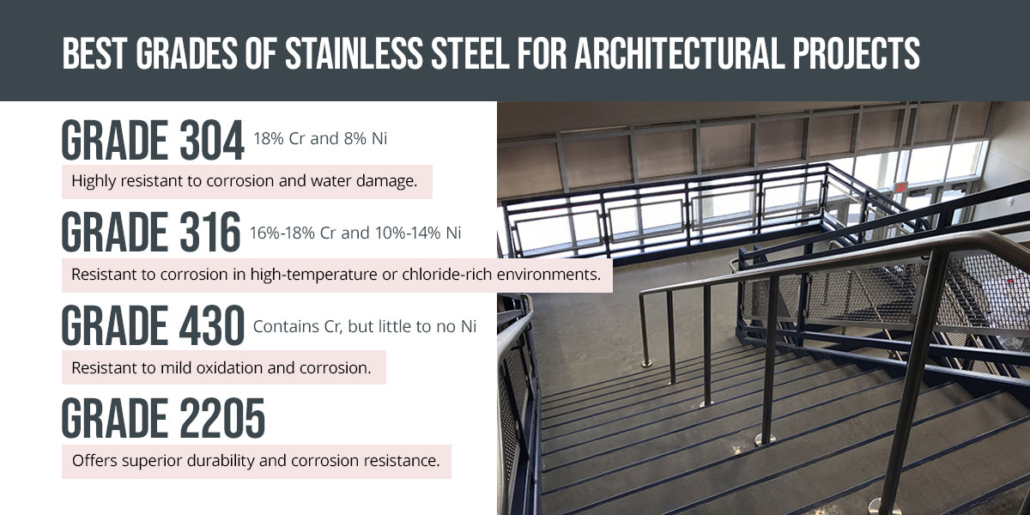
Grade 304

As the most common type of stainless steel, grade 304 contains about 18% chromium and 8% nickel. This combination creates a stable passive layer, making it highly resistant to corrosion and water damage. This austenitic alloy is ideal for metal castings, such as facades, cladding and handrails. It is widely available in many gauges and finishes, with costs ranging from low to moderate.

Corrosive elements from salt spray and de-icing salts can cause staining in 304 stainless steel. Because it is vulnerable to city pollutants and chloride attacks near the coast, grade 304 is best used in areas with a mild climate.

Grade 316

Grade 316 stainless steel contains 16%-18% chromium and 10%-14% nickel. However, the addition of 2% molybdenum makes grade 316 stainless steel particularly resistant to corrosion in high-temperature or chloride-rich environments, such as coastal areas and big cities.

This alloy is extremely useful in urban, marine, food processing and industrial settings. For example, 316 is used in city infrastructure that faces high levels of pollution. You can also find 316 stainless steel in chlorinated fountains and pools.

What is the difference between 304 and 316 stainless steel? While 304 is best for general construction, 316 is better for harsh atmospheres. Grade 316 typically involves higher up-front costs than grade 304, but it offers a better return on investment by minimizing maintenance and replacement costs in high-exposure areas.

Grade 430

As a ferritic stainless steel, grade 430 contains chromium, but little to no nickel. Its resistance to mild oxidation and corrosion makes it a great choice for indoor architectural applications, including appliances and decorative trim. Unlike austenitic grades, grade 430 is useful for magnetic mounting systems.

You can usually find 430 stainless steel at more stable, affordable prices because it contains less nickel. It also offers lower corrosion resistance than the 300 series and can rust when exposed to humid environments.

Grade 2205

Because it combines the structures of austenitic and ferritic grades, 2205 stainless steel offers superior durability and corrosion resistance. As such, grade 2205 is ideal for applications where strength is paramount, such as cladding, beams and bridges, particularly in coastal settings where saltwater exposure is high. This duplex grade is favored in oil, gas, marine and chemical processing industries.

The price of grade 2205 is generally higher than other grades. However, its unique strength allows it to be fabricated in smaller quantities while still carrying the same load.

Choosing the Right Grade for Your Needs

When selecting a stainless steel grade for architectural purposes, it’s important to weigh budget, corrosion resistance and construction needs. Consider the following factors in common stainless steel grades:

Grade 304 Grade 316 Grade 430 Grade 2205
Classification Austenitic Austenitic Ferritic Duplex
Corrosion Resistance High Very high Moderate Extremely high
Characteristics Durable, easy fabrication Strong, corrosion and temperature resistance Oxidation and temperature resistance Structural integrity, corrosion and cracking resistance
Environments Mild, low-risk Harsh, marine, urban Mild, low-risk Harsh, marine, urban
Common Applications Cladding, panels, elevators Facades, railings, fasteners Trim, appliances, decoration Bridges, facades, columns
Cost Low to moderate Moderate to high Low High

Explore Stainless Steel at Nationwide Architectural Metals

Explore Stainless Steel at Nationwide Architectural Metals

Nationwide Architectural Metals can source and fabricate stainless steel across a variety of grades, including 303, 304, 316 and low-carbon variants. Our stainless steel comes in sheets, plates, tubes, bars and rods for a wide range of commercial and industrial applications. Along with stainless steel, our lineup of pre-polished metals includes brass, bronze and aluminum.

As a leading metal supplier with over 40 years of expertise, Nationwide Architectural Metals is a reliable source of metal fabrication. Our team works closely with estimators and managers to ensure successful outcomes. We understand that each project is different, and we are proud to deliver custom fabrication services tailored to your unique architectural needs.

If you are looking for a specific type of metal, we are ready to bring your unique vision to life. To learn more about the best grades of stainless steel for your project, contact a specialist today.

When selecting a metal for outdoor projects, it’s essential to find a balance between visual appeal and weather resistance. Choosing the wrong alloy for open-air environments can lead to erosion, rust and structural instability. Thus, you’ll want to prioritize durability and maintenance in your selection. Aim to use a metal that can endure harsh conditions.

Whether you’re looking to construct stairs, trim, railings or custom designs, choosing the right metal makes all the difference. This guide will walk you through the best metals for external applications to help you make an informed decision. Read on to learn about the best weather-resistant metals for outdoor use.

Environmental Stressors on Outdoor Metalwork

Because outdoor metalwork is exposed to the elements, it is susceptible to corrosion. When choosing a metal, it’s helpful to understand the environmental conditions it will face.

Properties located near coastlines are vulnerable to aggressive chloride attacks. These salt particles attract moisture, keeping structures wet for extended periods of time. Increased salinity is known to corrode metal, potentially affecting structural stability.

Additionally, water can cause oxidation, which is what causes iron to rust. Crevices and horizontal surfaces can trap excess moisture. As such, humid environments call for durable alloys with strong protective layers.

Along with moisture, certain strong gases can corrode metal. For example, sulfur dioxide is released during industrial processes, posing a risk for metal infrastructure in urban areas. Heat may also damage metal by weakening its surface. Extreme temperature cycles and UV rays can stress joints through constant expansion and contraction.

While it’s not always possible to avoid environmental factors, certain metals can resist the effects of corrosive particles, heat, moisture and strong weather.
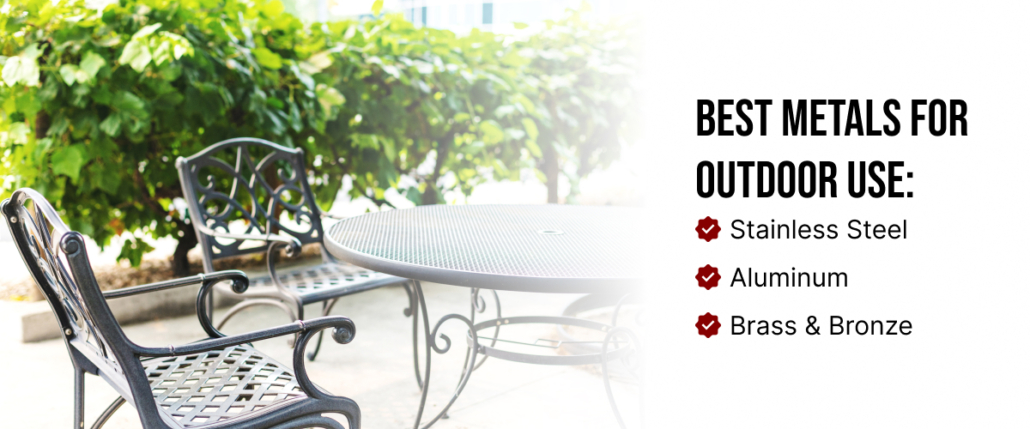
Best Metals for Outdoor Use are Stainless Steel, Aluminum, Bronze, & Brass

Best Metals for Outdoor Use

A few alloys stand out for their strength and longevity. Here are some of the most commonly used metals in outdoor applications.

Stainless Steel

Stainless steel is a popular choice in outdoor metalwork. Its sleek, modern appearance and corrosion resistance make it ideal for modern architecture. Many skyscrapers, bridges and other outdoor installations use stainless steel for its long-lasting durability. Stainless steel protects itself with an ultra-thin self-healing layer. This kickstarts chemical passivation, which ultimately prevents corrosion.

Alloy grade is an important factor in outdoor performance. Keep in mind that lower grades of stainless steel may still be at risk of corrosion, especially in coastal environments. Grade 304 is used in most stainless steel applications because it has chromium for strength. However, grade 316, or marine-grade stainless steel, offers improved corrosion resistance in harsher environments.

The term “stainless” may lead people to believe that no maintenance is needed, but regular cleaning can help remove contaminants before they reach the passive layer. Treating stainless steel with protective coatings is one way to further protect against damage. You can clean stainless steel with warm water and mild soap, but steer clear of abrasive cleaners like bleach or ammonia. Otherwise, make sure to keep surfaces dry and conduct regular checks for rust before it becomes a significant issue. You can treat discoloration early on with a stainless steel cleaner.

Aluminum

Aluminum is an affordable, heavy-duty metal highly favored for outdoor use. It has a convenient strength-to-weight ratio, making it both lightweight and durable. Because of this, aluminum is easy to move. People like to use aluminum for heavy gates, railings and other building components.

Like stainless steel, aluminum forms an invisible oxide coating that prevents rust from penetrating. Aluminum is a great choice if you’re looking for a convenient, low-maintenance metal that lasts for a long time outdoors. The Shaftesbury Memorial Fountain in London, also known as the Eros statue, is a notable example of an untreated aluminum structure.

Because of its protective layer, aluminum does not rust. However, like all metals, it is still prone to oxidation and corrosion. You can shield aluminum fixtures from moisture and oxygen by adding protective coatings. You can also anodize aluminum for better protection. Anodizing thickens the natural oxide layer for a harder surface. Wash aluminum surfaces with a soft cloth or sponge, gentle soap and warm water as a preventive measure. Rinse it well to prevent soap streaks.

Brass and Bronze

Copper alloys like brass and bronze are known for their corrosion resistance and timeless, shiny appearance. These metals resist rust and corrosion, though they eventually age into a blue-green patina called verdigris, a product of oxidation. Many designers choose copper for this very reason. For example, the Statue of Liberty’s iconic green hue is a result of verdigris.

Copper’s patina is more than a visual change — it becomes a protective shell, preventing further weathering. As such, you don’t need to add clear coats, as these can lead to peeling. You can clean brass and bronze surfaces with mild soap and water. Afterward, dry them with a towel to prevent water damage.

Keep in mind that brass and bronze are heavier and sometimes more expensive, meaning they might require more planning. However, these alloys provide both long-term protection and a distinctive look, making them an excellent choice for decorative outdoor fixtures.

Finding the Right Metal for Your Project

Before settling on a metal for the outdoors, think about how these factors align with your specific design needs:

Stainless Steel Aluminum Brass or Bronze
Strength High Moderate Moderate
Maintenance Low Low Low
Aesthetics Sleek, modern Versatile, minimalist Timeless, patina
Corrosion Resistance High High High
Weight Heavy Lightweight Heavy
Best Applications Railings, bridges, outdoor kitchens Fencing, windows, pergolas, patio furniture Statues, fixtures, decorative accents

When planning an outdoor project, the right type of metal can make all the difference. Each metal offers unique benefits, from visual appeal to low maintenance needs. Ultimately, the metal you use should resist corrosion when installed outdoors.

Bear in mind that, along with the alloy chosen, certain fabrication techniques, protective coatings, weld quality and slopes or drainage holes can also minimize damage from moisture and harsh weather.
Explore Outdoor Metals at Nationwide Architectural Metals

Explore Outdoor Metals at Nationwide Architectural Metals

With over 40 years of expertise in metal solutions, Nationwide Architectural Metals is a trusted source for architectural and ornamental metal fabrication. We deliver durable decorative metals tailored to your design needs. Our lineup of quality pre-polished metals comes in a variety of shapes, sizes and finishes. When requirements exceed what a traditional metal shop can handle, we complete unique requests with precision and care.

We are proud to provide clients with a wide selection of pre-polished metals, including stainless steel, bronze, brass and aluminum. Our team offers a range of custom services to help bring your project to life. For more information on choosing the right materials for your project, contact an expert today.