For project managers and estimators in manufacturing and fabrication, the choice between waterjet cutting vs. laser cutting is a critical decision that directly impacts budgets, timelines and product quality. Selecting the correct method is essential for minimizing material waste, preventing unnecessary secondary finishing and ensuring that parts meet specifications.
Nationwide Architectural Metals, Inc. can help you select the most effective and cost-efficient method for your specific project requirements.
A Technical Overview of Each Cutting Process
The fundamental difference between waterjet and laser cutting lies in how each technique removes material. Laser cutting is a thermal process that uses a high-powered, focused beam of light to melt or vaporize the material, creating a small heat-affected zone (HAZ).
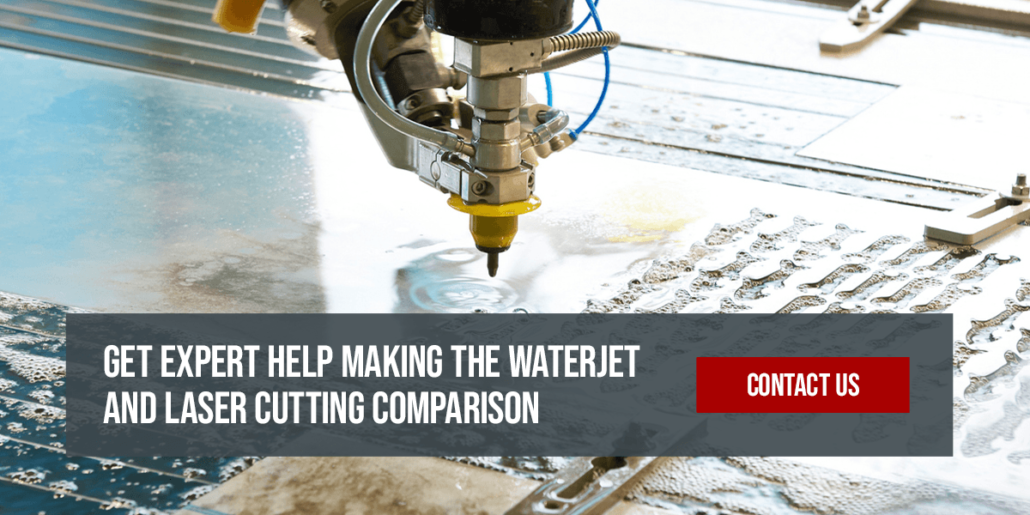
In contrast, waterjet cutting is a mechanical erosion process. It uses a supersonic, high-pressure stream of water mixed with an abrasive garnet to cut through materials without generating heat, thus eliminating any HAZ.
Key Decision Factors
When determining whether laser or waterjet cutting is the optimal choice for your project, consider these four key factors:
- Material compatibility and thickness: Waterjet offers unparalleled versatility to cut nearly any material, from thick stainless steel and aluminum to composites, laminates, stone and glass. Laser cutting is primarily for metals and is significantly faster on thin to medium-gauge sheets — typically under 1 inch — making it ideal for high-volume sheet metal fabrication.
- Precision and edge quality: One of the key advantages of waterjet cutting vs. laser cutting is that the former offers no thermal distortion, making it essential for aerospace components or heat-treated alloys where compromised material integrity is unacceptable.
- Cost-effectiveness: The waterjet vs. laser cutting cost comparison depends on the application. For high-volume, thin metal parts, laser cutting is generally faster and more affordable. For thick, reflective or heat-sensitive materials where lasers are not an option, waterjet becomes the most cost-effective solution.
Get Expert Help Making the Waterjet and Laser Cutting Comparison
Ultimately, the best cutting method is entirely dependent on your project’s unique needs. Partnering with a fabricator that has deep expertise and advanced equipment in both technologies is crucial to ensuring you receive an unbiased, effective solution.
NAM has the experience and in-house capabilities to handle your project, whether it requires the speed of laser cutting or the versatility of a waterjet. Contact our team today for a custom quote and to ensure the completion of your project with precision and quality.