The U.S. elevator installed base will approach 1.26 million units by 2030 — a massive network of machines people ride every day without noticing the components that make them work.
Every elevator relies on sills at each entrance and cab opening. These quiet, unglamorous parts guide the doors, support traffic and keep the system running smoothly.
Cab, hoistway, extension and saddle sills serve different purposes, and materials like stainless steel, brass, bronze and nickel silver offer varying durability and performance levels. Knowing how these distinctions affect wear, alignment and long-term reliability ensures accurate specification from the start.
What Are Elevator Sills?
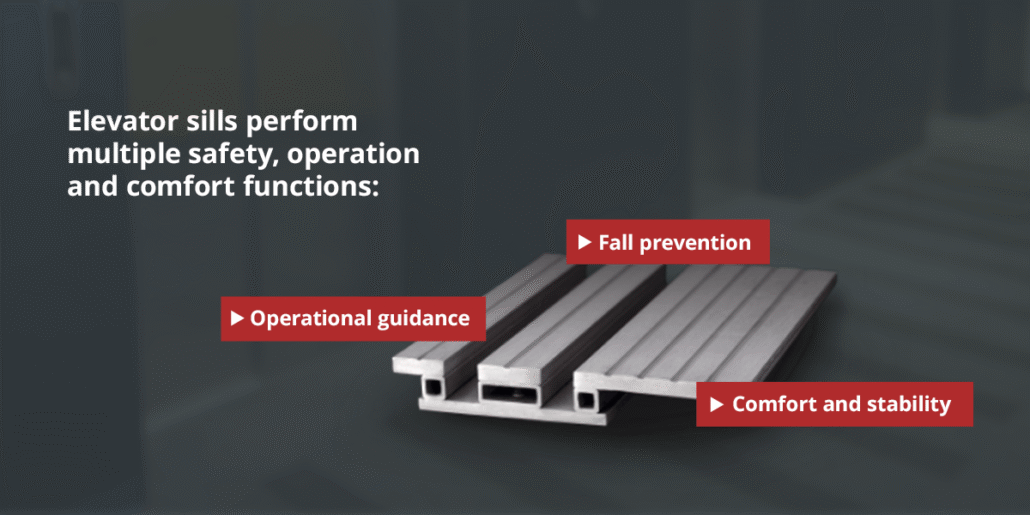
Elevator sills are horizontal metal components positioned at the base of the elevator cab opening and each floor landing entrance. They perform multiple safety, operation and comfort functions.
- Fall prevention: Sills create a secure transition between the cab and landing, preventing falls into the hoistway.
- Operational guidance: Sill grooves guide door gibs as doors open and close, maintaining correct door tracking.
- Comfort and stability: Properly specified sills reduce door rattling and vibration, improving the passenger experience.
The ASME A17.1/CSA B44 Safety Code for Elevators and Escalators mandates that landing sills be metal and structurally engineered to support loading and unloading. Finite element analysis identifies the sill and upper car fixing as one of the most structurally stressed components in an elevator car, making the correct components vital.
Types of Elevator Sills
Sill selection starts with determining which type your project requires.
Cab Sills
The cab sill, mounted at the base of the elevator car opening, contains a groove for the doors to travel along as they open and close, providing the surface passengers step across.
Because it moves with the car and aligns precisely with hoistway sills at every floor, a cab sill must maintain tight dimensional tolerances and withstand continuous foot traffic. Material selection and surface finish directly impact long-term performance in this high-wear environment.
Hoistway Sills
The hoistway sill is a counterpart to the cab sill. Fixed at each floor landing, these sills remain stationary as the elevator travels. When the elevator arrives at a floor, the cab and hoistway sills must align precisely to allow smooth, safe door movement and a flush transition surface.
Misalignment between these two components is one of the most frequent causes of door performance issues. While an elevator car only has one cab sill, it must integrate with the hoistway sill on each floor the elevator serves. Material consistency and supplier reliability are critical for multistory projects, since every hoistway sill should match the cab sill’s dimensions.
Extension Sills
Extension sills address wider elevator entrances that standard sills cannot fully cover, expanding beyond typical dimensions to span the complete opening width. These sills are typical in custom new builds and modernization projects where existing structural openings may not conform to conventional dimensions. Because extension sills are nonstandard, they often require a supplier with robust custom fabrication capability.
Saddle Sills
Saddle sills are valuable in remodeling and restoration projects where the sill and existing floor sit at slightly different heights. They create a smooth, flush transition between surfaces while their low-profile design minimizes trip hazards. Material and finish should match or complement the primary sill for visual consistency.
Elevator Sill Materials — What to Specify and Why
Material choice directly impacts a sill’s durability, presentation, maintenance requirements and cost of ownership. The four industry-standard materials — stainless steel, brass, bronze and nickel silver — suit different project environments and design goals.
Stainless Steel
Stainless steel is a widely specified material in commercial and institutional settings, often considered one of the best materials for elevator sills.
Stainless steel elevator sills are the best fit for high-traffic environments, including hospitals, transit facilities, airports, schools and commercial buildings. Multiple finish options are available, from brushed satin to mirror polish. Many alloy grades are also available, including 304/304L for standard applications and 316/316L for corrosive or moisture-heavy environments.
Beyond its technical properties, stainless steel’s clean, modern aesthetic makes it a popular choice for contemporary commercial designs. Stainless steel’s core properties include the following.
- Corrosion resistance: Withstands moisture, cleaning chemicals and environmental exposure.
- High tensile strength and impact resistance: Handles heavy traffic and loading stress.
- Minimal maintenance requirements: Requires only routine cleaning to maintain appearance.
Brass
Brass is the classic choice for high-traffic commercial environments that require warm aesthetics and increased durability.
Brass elevator sills are a good fit for hotel lobbies, office building entrances and commercial properties where the warm golden finish matches other classic design elements. Multiple brass alloys are available, including 230 Red Brass, 260 Yellow Brass, 360 Yellow Brass and 464 Naval Brass.
- Excellent wear resistance: Maintains dimensional stability under foot traffic.
- High ductility: Allows complex custom profiles.
- Strong resistance to moisture and cleaning chemicals: Performs well in demanding environments.
- Design flexibility: Accommodates intricate architectural detailing.
Bronze
Bronze is the preferred material for renovation projects on historic buildings and architecturally significant properties where matching the original finishes is essential. Its features include the following.
- Excellent mechanical strength and toughness: Withstands structural loads and impact.
- Strong resistance to corrosion: Handles moisture and cleaning agents effectively.
- Ability to be formed into complex architectural profiles: Supports detailed custom work.
- Natural patina development over time: A desirable quality in heritage applications.
Nickel Silver
Nickel silver is the premium option for high-end applications that require a refined silver aesthetic, including luxury residential towers, Class A commercial buildings, upscale hospitality and any other application where maintaining a polished appearance matters. It offers many advantages.
- Copper-nickel-zinc alloy composition: Delivers high strength and wear resistance.
- Corrosion resistance: Maintains finish integrity over time.
- Bright, polished finish: Warmer in tone than stainless steel.
- Low maintenance requirements: Retains aesthetic consistency with minimal upkeep.
How to Choose an Elevator Sill Provider
Custom elevator sills often meant long lead times, high costs for nonstandard dimensions and fragmented sourcing. An experienced, capable supplier changes that equation. Decades of hands-on fabrication experience mean technical staff who can interpret complex specs, recommend solutions for nonstandard openings and flag potential issues.
When a manufacturer has all the materials in stock, projects avoid the delays and coordination of split orders. Flexible production that accommodates single-unit replacements and high-rise projects eliminates constraints of minimum order quantities.
Contact Nationwide Architectural Metals, Inc. for Your Elevator Sill Needs
Nationwide Architectural Metals manufactures elevator sills in stainless steel, brass, bronze and nickel silver — all under one roof in North Carolina. With over four decades of specialized experience, we produce custom sills with no minimum run size.
Our patented OmniSills modular design enables faster production on nonstandard dimensions without the lead times or cost premiums typical of traditional custom fabrication. Whether your project requires a single saddle sill or hoistway sills across multiple floors, we deliver on spec and on schedule. Contact our team to request a quote.