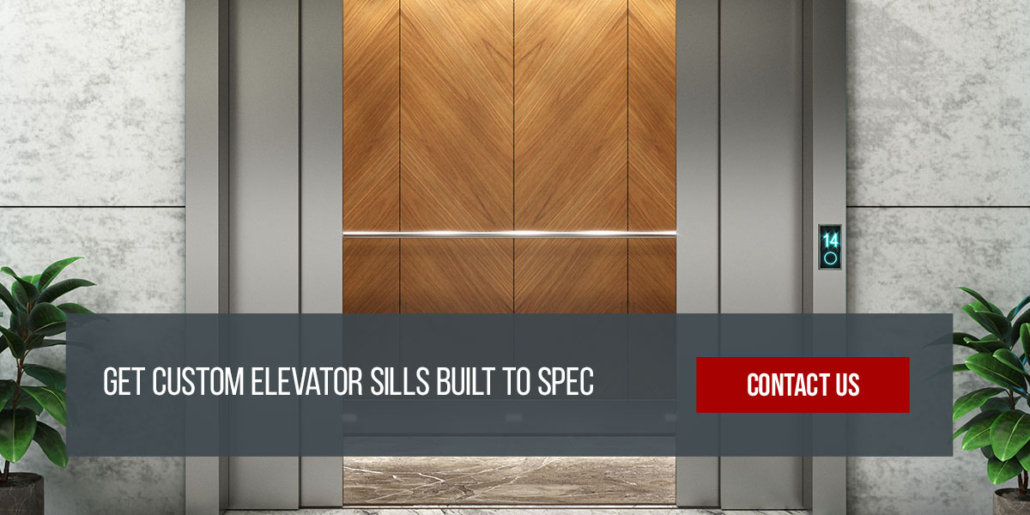
You know exactly what your entrance configuration requires. Finding a supplier who can actually deliver it is another story. Standard sill catalogs rarely account for non-standard openings or unconventional dimensions, and the moment your spec falls outside a supplier’s standard range, lead times stretch and costs climb. When the finished product arrives as almost correct, but not quite right, the fit problems and finish mismatches become your problem to solve.
For project managers and estimators specifying elevator components, the best options for custom elevator sills do more than fill a gap. They save time and keep production schedules on track. The answer comes down to material selection and supplier capability, and not every custom sill solution is built to the same standard.
Custom vs. Standard Elevator Sills
Comparing custom and standard elevator sills is an important part of determining what each option can and cannot do. There are areas where standard sills can still fall short, including:
- Fixed catalog profiles that can’t accommodate non-standard entrance widths or complex opening configurations.
- Gaps in wider entrances that extension sills are specifically designed to bridge.
- Limited finish options for aesthetic coordination with surrounding metalwork.
- Potential field modifications to make standards fit, adding time, cost and risk.
The global elevator market is expected to continue growing through 2030, with modernization remaining a key driver of demand for high-quality custom components.
Comparing Elevator Sill Materials
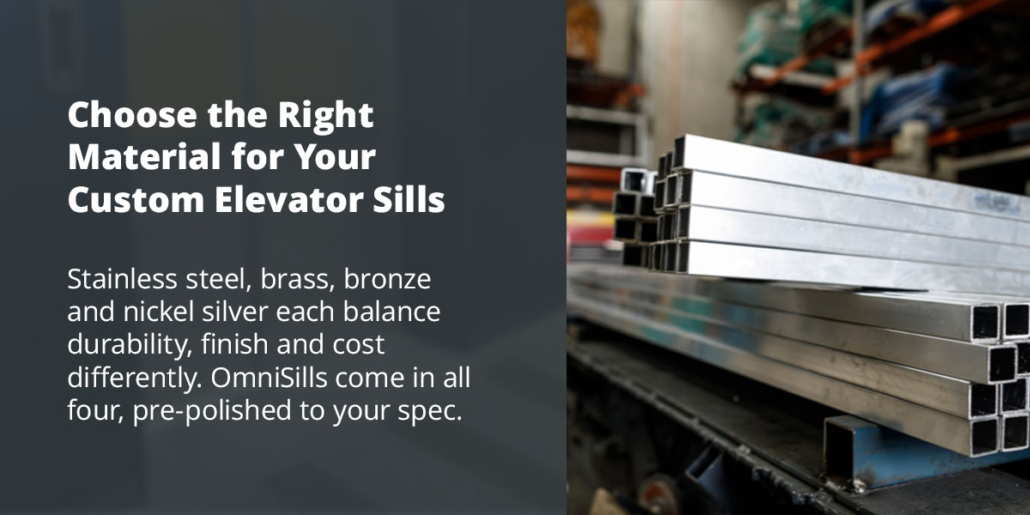
The definition of high-performance elevator sills varies depending on your project’s performance and organizational needs. Choosing the right type of elevator sill material is what narrows down your options, since this decision impacts durability, presentation, maintenance requirements and cost of ownership.
Stainless Steel
Stainless steel is a widely specified material for high-traffic elevator applications. Its strength and corrosion resistance mean it can withstand foot traffic, moisture exposure and mechanical stress in busy environments without degrading. For standard interior applications, 304 stainless steel delivers reliable durability at a practical cost.
For environments with direct moisture exposure or chemical cleaning agents, upgrading to 316 stainless steel provides the enhanced corrosion resistance those conditions demand. Stainless steel elevator sills are often used for hospitals, transit facilities, airports, schools and buildings where long-term performance is a priority.
Brass
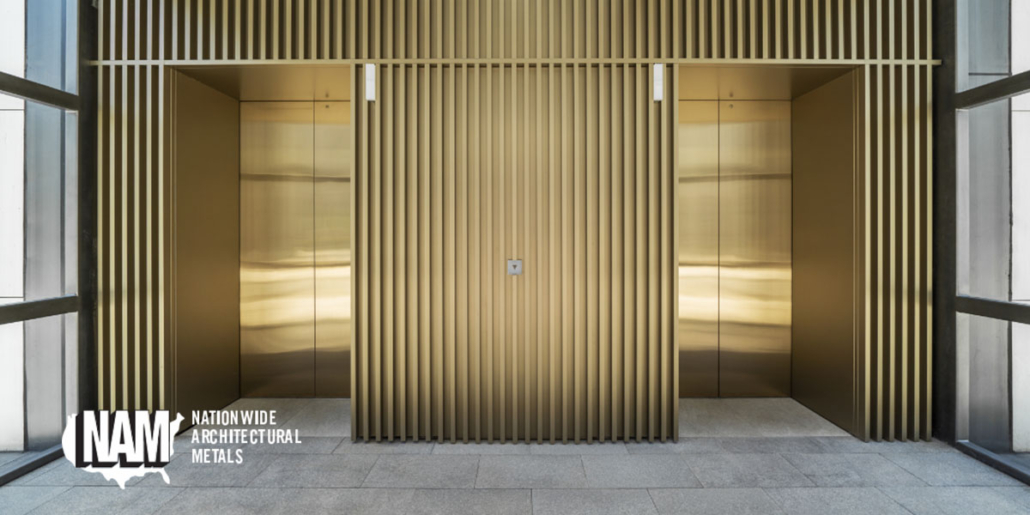
Brass elevator sills have the structural durability needed to handle repeated impact and abrasion. It typically comes with a warm, inviting golden finish that coordinates naturally with classic architectural metalwork. Highly workable without compromising strength, brass materials can be formed into complex sill profiles and detailed architectural features.
Its resistance to corrosion, moisture and cleaning chemicals supports long-term structural integrity and appearance in demanding indoor environments. This makes brass a popular choice for hotel lobbies, office building entrances and commercial properties looking to complement warm-toned or classic metalwork.
Bronze
Bronze elevator sills typically match original finishes on historic or architecturally significant buildings. However, their application extends to modern architectural designs that require a warm aesthetic and durability. Bronze endures heavy foot traffic and repeated use without compromising appearance or performance. Its natural patina, a thin protective oxide layer, helps to protect the metal from further corrosion.
Nickel Silver
Nickel silver is typically a copper, nickel and zinc alloy. It delivers a refined silver aesthetic and clean, modern appearance without the costs associated with real silver. Nickel silver is commonly used in luxury residential buildings and Class A commercial buildings.
What to Look for in a Custom Elevator Sill Supplier
Plenty of suppliers claim custom capability, but the promise and the delivery don’t always match. If gaps, misaligned finishes or delayed shipments have derailed your project before, it’s important to know which standards separate suppliers who can deliver genuine custom work from those modifying a standard catalog and calling it custom.
Fabrication Precision and Ready-to-Fit Design
A supplier who claims custom capability but still relies on catalog profiles may leave you with gaps, misalignments and field problems to solve on your own. What you actually need is a supplier whose fabrication process starts from your spec, backed by a technical team that can identify solutions for non-standard openings and flag issues before they become costly project problems.
OmniSills addresses this through patented elevator sill technology built on a modular design, helping NAM produce non-standard dimensions on faster timelines. Every OmniSills profile arrives pre-polished and dimensionally precise, ready to fit your entrance configuration to spec, with no minimum run size required.
Finish Quality and Aesthetic Matching
A sill that’s dimensionally correct but aesthetically mismatched can still create callbacks and change orders. A capable supplier needs deep finishing expertise, not just fabrication capability. For Nationwide Architectural Metals (NAM), that expertise traces back to a father-son legacy of hands-on leadership in metal polishing and finishing, with finish options ranging from #3 satin to super mirror polish across all four OmniSills materials.
Every profile leaves the shop with the finish specified from the start, so your sill matches the surrounding metalwork on its first arrival.
Lead Time, Cost and Compliance
Evaluating a custom elevator sill supplier can come down to three crucial procurement criteria. These can determine whether your project stays on schedule, on budget and on the right side of code:
- Lead time: OmniSills are fabricated and delivered in days, not months. With all four materials stocked and manufactured under one roof, there are no split orders to coordinate and no third-party delays to absorb.
- Cost: Evaluate cost in terms of fit, durability and project requirements rather than unit price alone. A sill designed for long-term performance can help reduce replacement concerns in high-traffic environments.
- Compliance: The ASME A17.1-2025/CSA B44 safety code provides requirements for elevators and escalators in North America, making code-conscious material selection an important part of elevator sill specification.
These specialty fabrication solutions arrive to you on time, on spec and on budget as part of a standing guarantee.
Why OmniSills Are the Superior Choice for Custom Elevator Sills
Delivering a truly custom elevator sill is only half the challenge. The other half is whether the supplier behind it can meet every dimension of that promise at once, from fabrication precision to finish quality to lead time. OmniSills are available in all four materials: stainless steel, brass, bronze and nickel silver. Each high-performance elevator sill is precision-fabricated to your exact specification with no minimum run size.
OmniSills are built on patented elevator sill technology and use a modular fabrication process that enables NAM to produce non-standard dimensions on shorter timelines for complex project requirements. Every profile leaves the shop precision-fabricated and pre-polished.
These premium elevator sill solutions are purpose-built for non-standard openings, tight timelines and demanding aesthetic specifications.
Get Custom Elevator Sills From Nationwide Architectural Metals
Nationwide Architectural Metals backs every custom elevator sill order with a straightforward promise to arrive on time, on spec and on budget. Our OmniSills are fabricated and finished in North Carolina, so your project moves at the pace your schedule demands, not the pace of a fragmented supply chain.
Ready to see what a truly custom fit looks like? Explore our elevator sill solutions or contact us for a quote to get your project started.